

Watch a child halfway up a climbing wall and you can almost see the thinking. A hand reaches, pauses, changes its mind. A foot tests a hold, then moves to a better one. They look up, look down, and decide. What looks like simple play is a steady stream of small decisions, and that is exactly why climbing is so good for a growing brain.
The short answer: climbing builds thinking skills as much as physical ones. Every climb asks a child to plan a route, hold that plan in mind, judge risk, adjust when something does not work and keep going. Those are the same skills children later use for learning, focus and solving problems at school and beyond.
What Climbing Exercises, Skill by Skill
| Thinking skill | What it looks like on a climber |
|---|---|
| Problem solving | Working out which hold or rung comes next |
| Planning and memory | Holding a route in mind several moves ahead |
| Risk judgment | Deciding how high is high enough today |
| Spatial awareness | Judging distances, gaps and where the body fits |
| Focus and persistence | Trying again after slipping or getting stuck |
| Confidence | Reaching the top and getting down on their own |
| Cooperation | Sharing routes, taking turns and helping a sibling |
1. Problem Solving: Every Climb Is a Puzzle
A climbing frame is a puzzle with no instructions. Which rung is closest? Will this foothold hold me? Can I reach that bar from here? Children answer these questions dozens of times in a single session, testing ideas and adjusting when something does not work. Unlike a puzzle with one right answer, a climber usually has many routes, so children learn there is more than one way to solve a problem.
2. Planning and Working Memory
To get to the top, a child has to think a move or two ahead and keep that plan in mind while their body carries it out. This is an early workout for executive function, the set of mental skills that includes planning, working memory and self-control. The American Academy of Pediatrics' clinical report on play, "The Power of Play," highlights play as a key way young children build these executive function skills.
3. Learning to Judge Risk
Climbing gives children a safe way to practice something they will need for life: deciding what is too much. Each time a child climbs a little higher, then pauses, they are measuring their ability against a challenge. A 2015 systematic review of research on risky outdoor play found it was associated with more physical activity and better social health in children. Children who get regular, supervised chances to take small risks tend to become better at judging bigger ones.
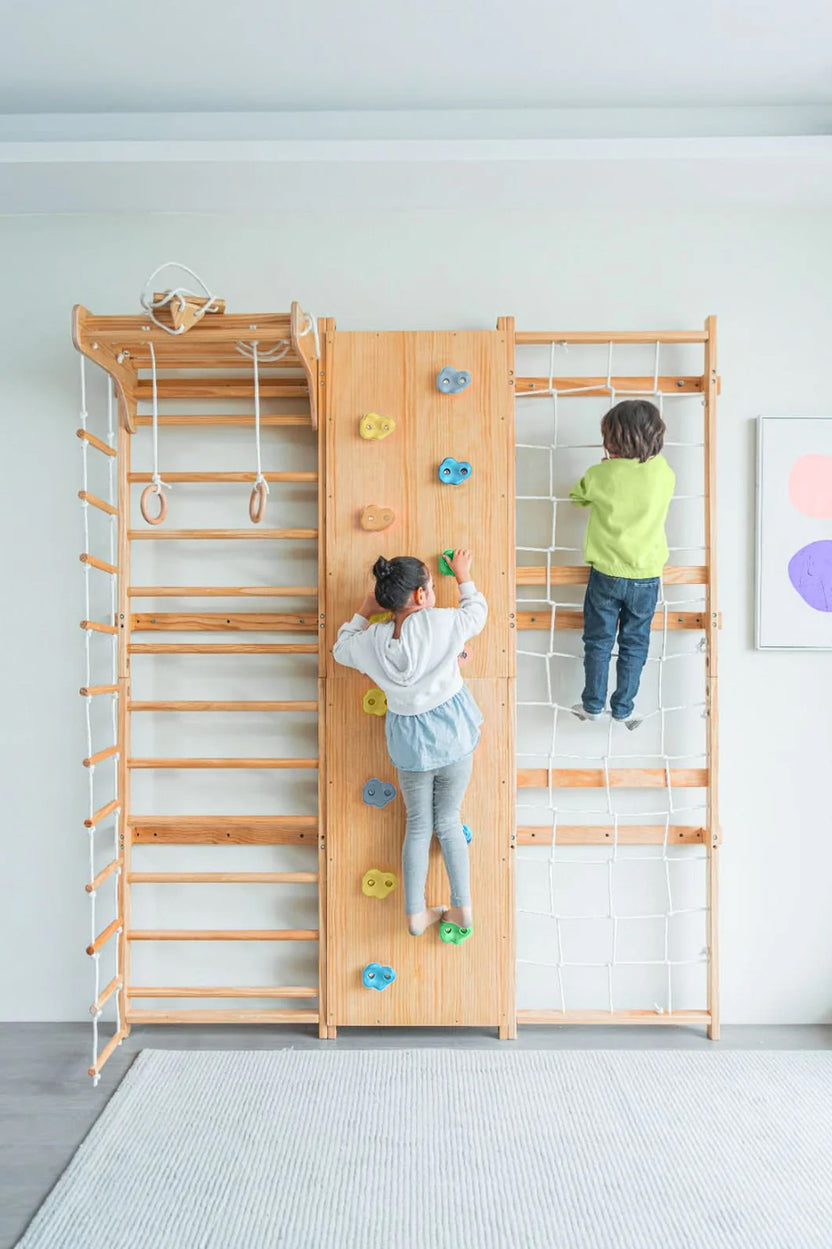
4. Spatial and Body Awareness
Climbing teaches children how their bodies fit into space: how far they can reach, how big a gap they can cross and how to shift their weight to stay balanced. This sense of body position, called proprioception, works alongside spatial reasoning, the ability to picture distances and shapes. Both show up later in everyday tasks, from catching a ball to fitting puzzle pieces together.
5. Focus and Persistence
A tricky climb demands full attention. Children tune out distractions to work on one move at a time, and when they slip or get stuck, they have to decide whether to try again. That cycle of trying, failing and trying a new way builds persistence, the willingness to keep working at something hard.
6. Confidence That Comes From Doing It Themselves
There is a particular kind of pride in reaching the top of something you climbed on your own. That feeling, knowing "I can do hard things," is called self-efficacy, and it grows from real accomplishments rather than praise alone. Getting down safely matters just as much as getting up, so let children work out the descent too.
7. Cooperation and Turn-Taking
When siblings or friends share a climber, they negotiate turns, follow each other's routes and help when someone gets stuck. Equipment built for two, like the Willow seesaw, only works when both children cooperate.

What Climbing Teaches at Each Age
| Age | What they are learning | Good climbing for this stage |
|---|---|---|
| Around 1 year | Cause and effect, and the first sense of "I can" | A low Pikler triangle to pull up on |
| 18 months to 2 years | Planning simple sequences and getting down safely | A low climbing gym like the Cherry |
| 2 to 3 years | Judging height, testing new routes | A jungle gym with options like the Magnolia |
| 3 to 5 years | Multi-step planning, persistence and real challenge | A wall gym with attachments like the Walnut |
For the physical milestones that go with each stage, see our guide to gross motor skills by age.
How to Coach Without Taking Over
The thinking happens when children solve the climb themselves, so the most helpful thing an adult can do is often to step back. Instead of lifting your child or placing their feet, try:
- "Where could your foot go next?" This prompts planning instead of giving the answer.
- "How will you get down?" This builds the habit of thinking ahead.
- "You worked hard on that." This praises effort, not just reaching the top.
- "Do you want to try a different way?" This encourages flexible thinking after a stumble.
Step in when a child is genuinely stuck, frightened or climbing beyond what they can safely get down from.
Bringing Climbing Home
A trip to the playground is wonderful, but the benefits of climbing come from regular practice, and a climber at home makes that practice possible every day, whatever the weather. For small spaces, the Grove mounts to the wall and folds flat, and a Swedish ladder like the Walnut uses wall space instead of floor space.

Keeping Climbing Safe
- Choose equipment matched to your child's age and size, with a stated weight limit.
- Put a padded mat on hard floors and keep a clear landing zone.
- Anchor wall mounted climbers into studs and check bolts regularly.
- Supervise young climbers, staying close without taking over.
Frequently Asked Questions
Is climbing good for brain development?
Yes. Climbing combines physical effort with constant decision making, which exercises problem solving, planning, working memory and risk judgment. The American Academy of Pediatrics recognizes play as an important way young children build these executive function skills.
What are the benefits of climbing for toddlers?
Climbing builds strength, balance and coordination, along with problem solving, spatial awareness and confidence. It also helps toddlers learn their own limits in a safe way.
Is it safe to let my toddler climb?
Yes, with age-appropriate equipment, a soft landing surface and supervision. Giving toddlers a safe place to climb also makes them less likely to climb furniture.
Should I help my child climb?
Help as little as needed. Children learn most when they work out the route themselves. Offer prompts like "Where could your foot go next?" and step in if they are stuck or frightened.
What is risky play?
Risky play is thrilling, physical play where children test their limits, like climbing high or moving fast. With supervision and safe equipment, research has linked it to better physical activity and social health.
At what age should a child start climbing?
Many children start pulling up and climbing low frames around their first birthday. A low Pikler triangle is a common first climber.
The Takeaway
Climbing is a workout for the whole child: muscles, balance and the thinking skills that support learning for years to come. Give children regular, safe chances to climb, let them solve the route themselves, and celebrate the effort as much as the summit. Explore our indoor climbers, or compare climbers by age in our climbers buying guide.