

Watch a toddler for ten minutes and you will see a body in training. Every climb onto the sofa, every wobbly step off a curb and every attempt to jump with both feet is practice for a skill that is still being built. These big-muscle movements are called gross motor skills, and they develop in a fairly predictable order, even though every child moves through them at their own pace.
The short answer: gross motor skills are the large movements of the arms, legs and core: sitting, standing, walking, climbing, jumping and balancing. Children build them through daily, hands-on practice. The most helpful thing a parent can do is give their child safe things to climb, balance on and move around, matched to their current stage.
Gross Motor Milestones at a Glance
These are typical milestones from the CDC's developmental guidelines. Most children reach them by around the ages shown, but a few weeks or months either way is normal.
| By around | Most children can | Good equipment for this stage |
|---|---|---|
| 9 months | Sit without support and get into a sitting position | Floor time, a low baby swing with supervision |
| 12 months | Pull up to stand and walk while holding furniture | A low Pikler triangle, a push walker |
| 18 months | Walk alone and climb on and off a couch or chair | A Pikler set with a ramp, a rocking boat |
| 2 years | Run, kick a ball and walk up a few stairs | A low climbing gym, a toddler slide, stepping stones |
| 2.5 years | Jump off the ground with both feet | Stepping stones, a balance beam, a seesaw |
| 4 years | Catch a large ball most of the time | An indoor jungle gym, a Swedish ladder |
| 5 years | Hop on one foot | Monkey bars, rope ladders, climbing walls |
6 to 12 Months: From Sitting to Standing
Babies spend this stage building the core strength to sit, then the leg strength to pull up and stand. Plenty of floor time is the foundation: it lets them roll, reach and crawl. Toward the end of the first year, most babies start pulling up on anything nearby and cruising along furniture.
A low, stable climbing frame gives that pulling-up instinct a safe target. A Pikler triangle like the Hazel has rungs at just the right height for gripping and standing. Gentle swinging in a seated baby swing like the Spruce also builds early balance and body awareness.
12 to 18 Months: First Steps and First Climbs
This is the stage of first independent steps, and of discovering that almost everything can be climbed. Toddlers practice stepping up, stepping down, and the much harder skill of getting back down from somewhere high.
Give them climbing they can manage on their own. A low Pikler triangle with a ramp, like the Maple or Olive, lets them climb up, turn around and come back down in a safe setting. The Rowan works two ways: as a rocking boat that builds balance and core strength, and flipped over as a stepped climbing bridge for practicing steps.

18 Months to 2 Years: Running, Kicking and Climbing Higher
Walking turns into running, and climbing gets more ambitious. Toddlers start kicking a ball, walking up stairs with help and climbing onto furniture with real confidence. Their balance is improving, but they still fall often, which is part of learning.
A low climbing gym gives this energy somewhere to go. The Cherry stays 43 inches tall, with a ramp, ladder, arch and slide that let toddlers climb, crawl and slide on their own. A folding toddler slide like the Holland adds a repeatable climb-and-slide loop that toddlers will do dozens of times in a row.
2 to 3 Years: Jumping and Balancing
This is when balance takes a big leap. Children learn to jump with both feet, walk along a line, step from one object to the next and keep their footing on uneven surfaces. They start to enjoy a challenge they can almost, but not quite, manage.
Balance equipment shines at this stage. The Majesty balance beam and stepping stones can be arranged into a new obstacle course every day, and the Willow works as a seesaw for two or a balance beam for one. For climbers ready for more height, the Magnolia adds a rock wall, rope ladder and monkey bars to grow into.

3 to 5 Years: Strength, Coordination and Bigger Challenges
Preschoolers combine skills: climbing while planning a route, swinging while holding on, hanging from a bar and dropping down safely. Upper-body strength grows, and by around five, most children can hop on one foot.
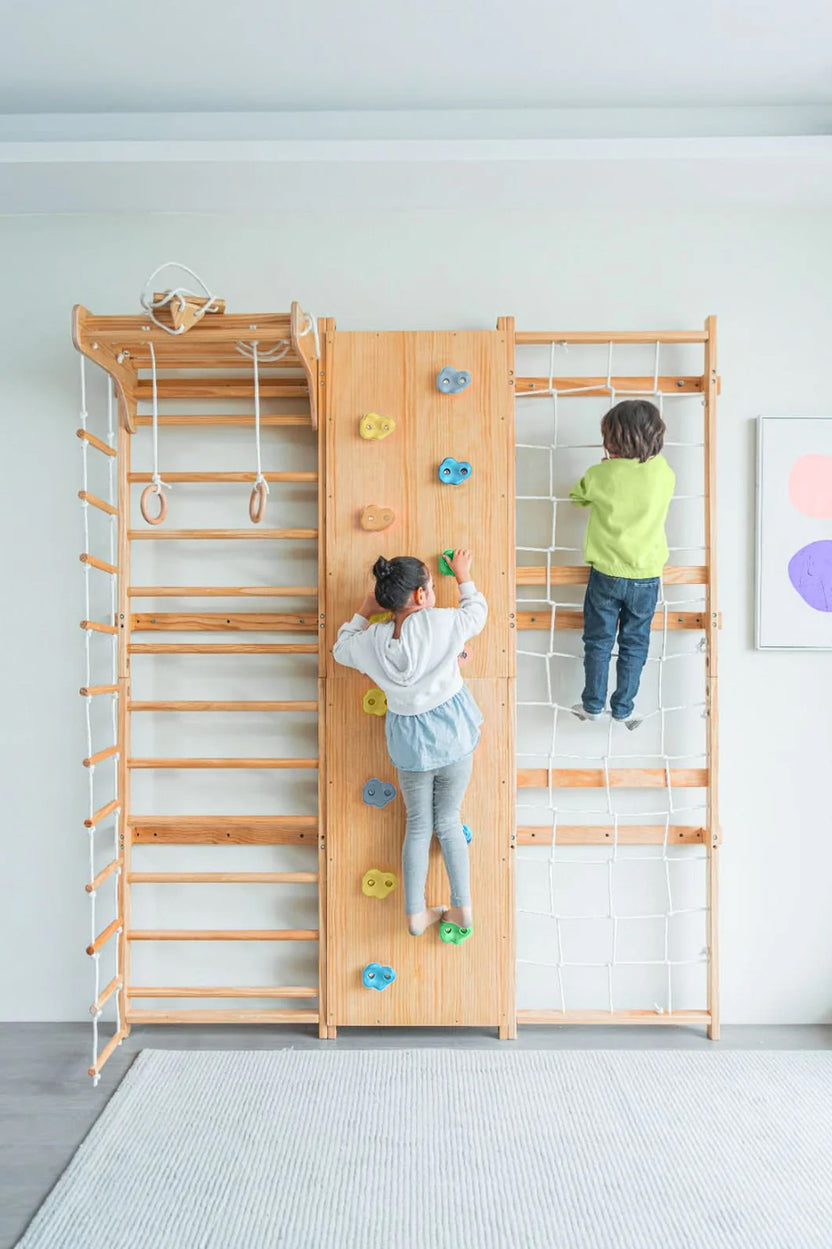
This is the age for monkey bars, rope ladders and climbing walls. A Swedish ladder wall gym like the Walnut puts all of them on one wall and keeps adding challenge with attachments like a pull-up bar. For smaller homes, the Grove mounts to the wall and folds flat after play.
Why Balance Deserves Extra Attention
Balance depends on two body systems working together. The vestibular system in the inner ear senses motion and head position, and proprioception tells the brain where each limb is without looking. Rocking, swinging, spinning and walking on narrow or uneven surfaces all exercise these systems, which is why balance activities show up again and again in early childhood play. Good balance underlies nearly every other movement skill, from running to riding a bike.
Five Easy Ways to Support Gross Motor Play at Home
- Create a yes space. Set aside one area where climbing, rolling and jumping are allowed, with a mat on hard floors.
- Let them try first. Step in when a child is truly stuck or climbing beyond what they can get down from, but let them work out the route themselves.
- Change the setup. Rearranging stepping stones or adding a ramp turns familiar equipment into a new challenge.
- Move every day. Short bursts throughout the day count. The WHO recommends that children ages 1 to 4 spend at least 180 minutes a day in a variety of physical activities.
- Match the challenge to the stage. Equipment should be just hard enough that your child can succeed with effort.
When to Talk to Your Pediatrician
Children develop at different rates, and a single late milestone is usually not a concern. Talk to your pediatrician if your child loses a skill they once had, seems much stiffer or floppier than other children their age, consistently uses one side of the body more than the other, or is well behind several milestones. Early support can make a real difference, and asking is always reasonable.
Frequently Asked Questions
What are gross motor skills?
Gross motor skills use the large muscles of the arms, legs and core. They include sitting, crawling, walking, running, climbing, jumping and balancing.
What is the difference between gross and fine motor skills?
Gross motor skills involve large, whole-body movements like climbing and jumping. Fine motor skills involve small, precise movements of the hands and fingers, like picking up a raisin or turning a page.
When do toddlers start jumping?
Most children can jump off the ground with both feet by around two and a half years old, according to the CDC's milestones.
How can I improve my toddler's balance?
Give them regular chances to walk on narrow or uneven surfaces, rock, swing and step from one object to another. Balance beams, stepping stones, rocking boats and low climbers are all good tools, used with supervision.
Is climbing good for toddlers?
Yes. Climbing builds strength, coordination, balance and problem solving, and it helps children learn their own limits. Provide safe, age-appropriate climbing equipment so they are less tempted to climb furniture.
What gross motor equipment is best for a 1 year old?
A low Pikler triangle with a ramp, a push walker or a rocking boat. Each supports pulling up, stepping and early balance at a safe height.
The Takeaway
Gross motor skills grow through practice, and children practice best when they have safe, interesting things to climb, balance on and move around every day. Match the equipment to the stage, let them lead, and keep the challenge just within reach. Explore our indoor play equipment, or compare climbers by age in our climbers buying guide.