
Sooner or later, every toddler wants to see what is happening on the kitchen counter. The question for parents is how to get them up there safely. The two most common answers are a step stool and a kitchen tower, and they are not the same thing.
The short answer: a step stool is fine for quick, supervised tasks like handwashing once a child is steady on their feet, usually from around age 3. For toddlers who want to stand at the counter and help cook, a kitchen tower is the safer choice, because its rails enclose the child on every side so they can use both hands without falling backward.
Kitchen tower vs. step stool at a glance
| Step stool | Kitchen tower | |
|---|---|---|
| What it does | Adds height | Adds height and encloses the child with safety rails |
| Best for | Quick tasks: handwashing, toothbrushing, reaching a shelf | Standing at the counter to cook, bake, wash fruit or help with dinner |
| Typical age | Around 3 years and up, once balance is steady | From about 18 months to 2 years, depending on the tower |
| Hands free? | No. Children often hold on or lean on the counter | Yes. Rails support the child so both hands can work |
| Fall risk | Higher. Nothing stops a step backward | Lower. Rails block backward and sideways falls |
| Footprint | Small and easy to move | Larger, about the size of a small chair |
| Cost | Lower | Higher, though convertible towers replace several pieces of furniture |
What is a step stool?
A toddler step stool is a small platform, often with one or two steps, that raises a child a few inches so they can reach a sink or counter. It is compact, inexpensive and easy to move from the bathroom to the kitchen.
The limitation is that a step stool only adds height. There is nothing around the child, so if they lean back, twist to look at something, or get excited mid-task, there is nothing to stop a fall. That is why step stools work best for short, simple jobs with an adult right beside them.
What is a kitchen tower?
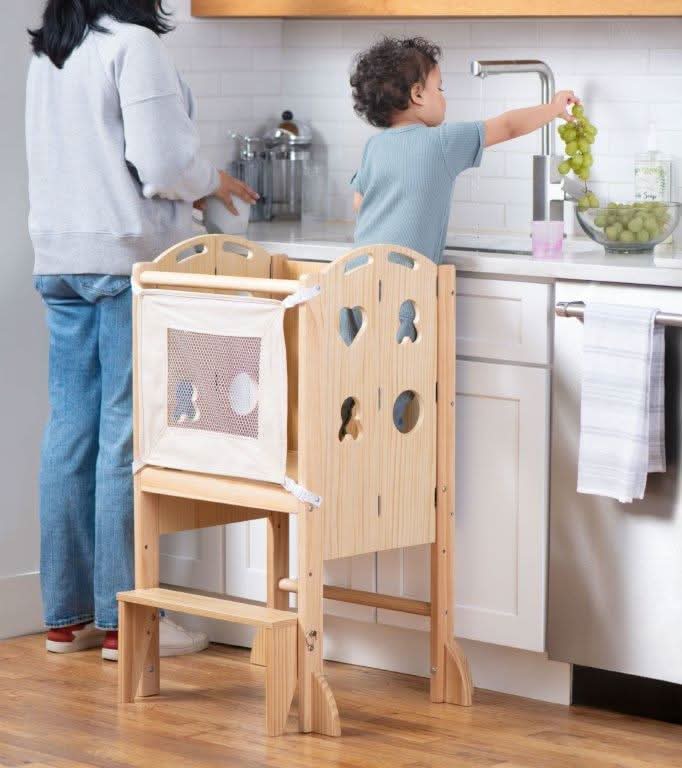
A kitchen tower, sometimes called a toddler tower or kitchen helper tower, is a raised standing platform surrounded by safety rails. The child climbs in, stands at counter height and is enclosed on all sides. Many towers have an adjustable platform so the height can change as the child grows.
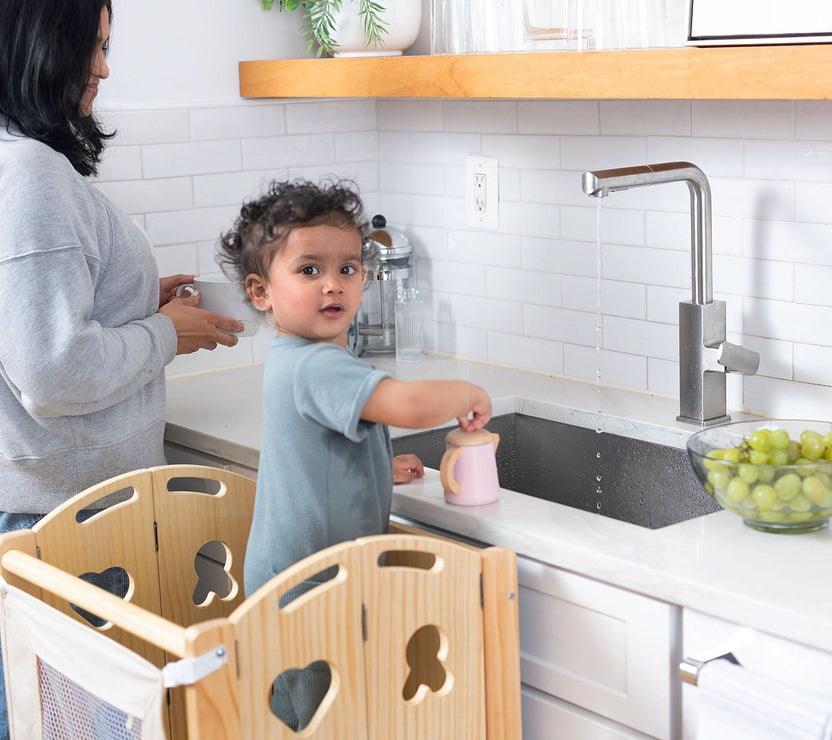
Because the rails do the job of keeping the child upright, toddlers can use both hands to stir, pour and wash. That is what makes real kitchen participation possible for children who are too young for an open stool.
Which is safer for toddlers?
For children under about 3, a kitchen tower is safer for anything longer than a quick handwash. Toddlers have a high center of gravity and are still developing balance, and falls from chairs, stools and counters are a common cause of household injuries in young children. An open stool leaves the back and sides unprotected. A tower encloses them.
No piece of equipment replaces supervision. Even in a tower, stay within arm's reach, especially near stoves, knives and hot pans.
When a step stool is enough
- Your child is 3 or older and steady on their feet
- The task is quick and simple: washing hands, brushing teeth, grabbing a cup
- An adult is standing right beside them
- You need something small that moves easily between rooms
When to choose a kitchen tower
- Your toddler is under 3 and wants to be at the counter with you
- You want them to help cook, bake or prepare snacks with both hands
- Your toddler tends to wiggle, turn around or climb
- You would rather have one sturdy piece that can grow with your child
What age can a toddler use a kitchen tower?
Most families introduce a kitchen tower between 18 months and 2 years, once a child can stand confidently on their own. Many children use one until age 5 or 6. Every tower lists its own age range and weight limit, so check the product details before buying.
As a rough guide:
- 18 months to 2 years: A kitchen tower with rails on every side. Keep sessions short and supervised.
- 2 to 3 years: The prime kitchen tower years. Toddlers can wash produce, stir batter and tear lettuce.
- 3 to 5 years: A tower for cooking, plus a step stool for quick tasks like handwashing.
- 5 and up: Most children can use a sturdy step stool for most tasks.
The Montessori case for kitchen towers
In Montessori education, everyday tasks like pouring, washing and preparing food are called practical life activities. They build fine motor skills, concentration and independence, and they let children contribute to real family work instead of watching from the floor.
A kitchen tower is one of the simplest ways to bring practical life into a home. It puts a child at the same height as the adults, so they can see, copy and help. Many parents find that giving a toddler a real job at the counter also cuts down on the climbing, pulling and frustration that come from being left out.
Convertible kitchen towers: one piece, several jobs
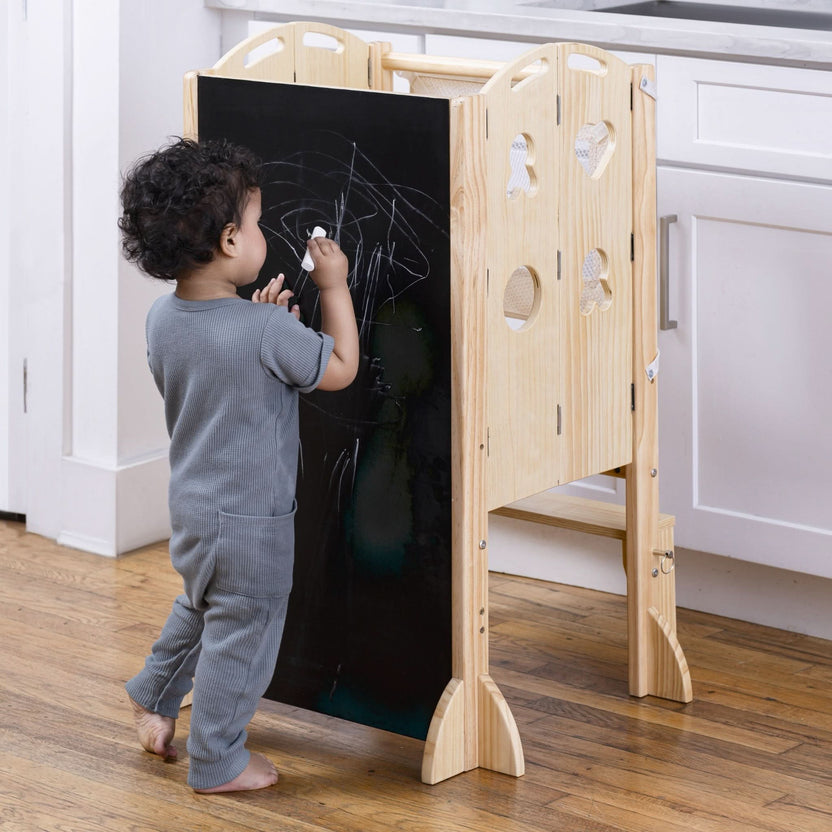
The biggest downside of a kitchen tower is size. A tower that only does one thing takes up floor space for years. Convertible and foldable towers solve that by turning into other furniture or folding away when cooking is done. Avenlur makes three:
- Date 4-in-1: A kitchen tower and step stool that converts into a desk and chair, with a built-in chalkboard. Best if you want a piece that becomes everyday furniture.
- Laurel 4-in-1: A foldable kitchen tower and step stool with a chalkboard and a slide. Best if you want a tower that doubles as play equipment.
- Plum 3-in-1: A foldable kitchen tower, step stool and chalkboard. Best for smaller kitchens where the tower needs to fold away.
What to look for in a kitchen tower
- Rails on every side: Full enclosure matters more than any other feature.
- A stable, anti-tip base: The tower should not rock or shift when a child leans or climbs.
- The right height: The platform should bring your child to about elbow height at your counter.
- A clear weight limit: Look for a stated limit that covers your child for several years. The Date holds up to 55 pounds, for example.
- Non-toxic finishes and smooth edges: Toddlers will chew, lean and grab everything.
- Easy cleaning: Kitchens are messy. A surface you can wipe with a damp cloth and mild soap will save you time.
- Room to grow: An adjustable platform, a foldable frame or a convertible design extends the years of use.
How to use a kitchen tower safely
- Place it on a flat, dry floor, flush against the counter.
- Keep it away from the stove, knives and hot appliances.
- Stay within arm's reach at all times.
- Teach your child to climb in and out facing the tower.
- Move it out of the kitchen or fold it away when not in use, so it is not climbed unsupervised.
Frequently asked questions
Is a kitchen tower better than a step stool?
For toddlers under about 3, yes. A kitchen tower encloses the child with rails so they can stand safely at the counter and use both hands. A step stool only adds height, which makes it better suited to quick tasks for older children.
What age is a kitchen tower for?
Most kitchen towers are designed for children from around 18 months to 2 years up to age 5 or 6. Check the specific tower's age range and weight limit.
What age can a toddler use a step stool?
Many children can use a step stool safely from around age 3, once their balance is steady, for short supervised tasks like handwashing.
Are kitchen towers safe?
Kitchen towers are designed to reduce fall risk by surrounding the child with rails. They are safest on a flat floor, pushed against the counter, with an adult within arm's reach.
Do I need both a kitchen tower and a step stool?
Not necessarily. Many families start with a kitchen tower and add a step stool for the bathroom later. A convertible tower that doubles as a step stool, like the Date, Laurel or Plum, can cover both jobs.
What is the best kitchen tower for a small kitchen?
A foldable tower. The Plum and Laurel both fold flat for storage between uses.
What is the difference between a kitchen tower and a toddler tower?
They are the same thing. Kitchen tower, toddler tower and kitchen helper tower all describe a raised platform with safety rails that brings a child to counter height.
The bottom line
If your toddler is under 3 and wants to help in the kitchen, choose a kitchen tower. If your child is older and just needs a boost at the sink, a step stool will do. For one piece that handles both, choose a convertible tower: the Date if you want a desk and chair later, the Laurel if you want a slide, or the Plum for a smaller kitchen. See our full range of kitchen towers.