

Montessori climbers have become a fixture of playrooms for a simple reason: toddlers want to climb, and these wooden pieces give them a safe place to do it. But the names can be confusing. Pikler triangle, arch, ramp, rocker, climbing gym. This guide explains each piece, what age it suits and how to choose a Montessori climbing set your child will use for years.
What Is a Montessori Climbing Frame?
A Montessori climbing frame is a wooden climbing structure designed for child-led movement. Children use it to pull up, climb, balance, crawl and slide, choosing their own challenge each time. The idea draws on the work of two pioneers. Dr. Emmi Pikler, a Hungarian pediatrician, believed babies and toddlers develop movement best when they are free to explore it at their own pace. Dr. Maria Montessori built an approach to learning around independence and simple, real materials. A Montessori climber brings both ideas together: a natural wooden structure that a child can explore without being directed.
The Pieces, Explained
The Pikler triangle
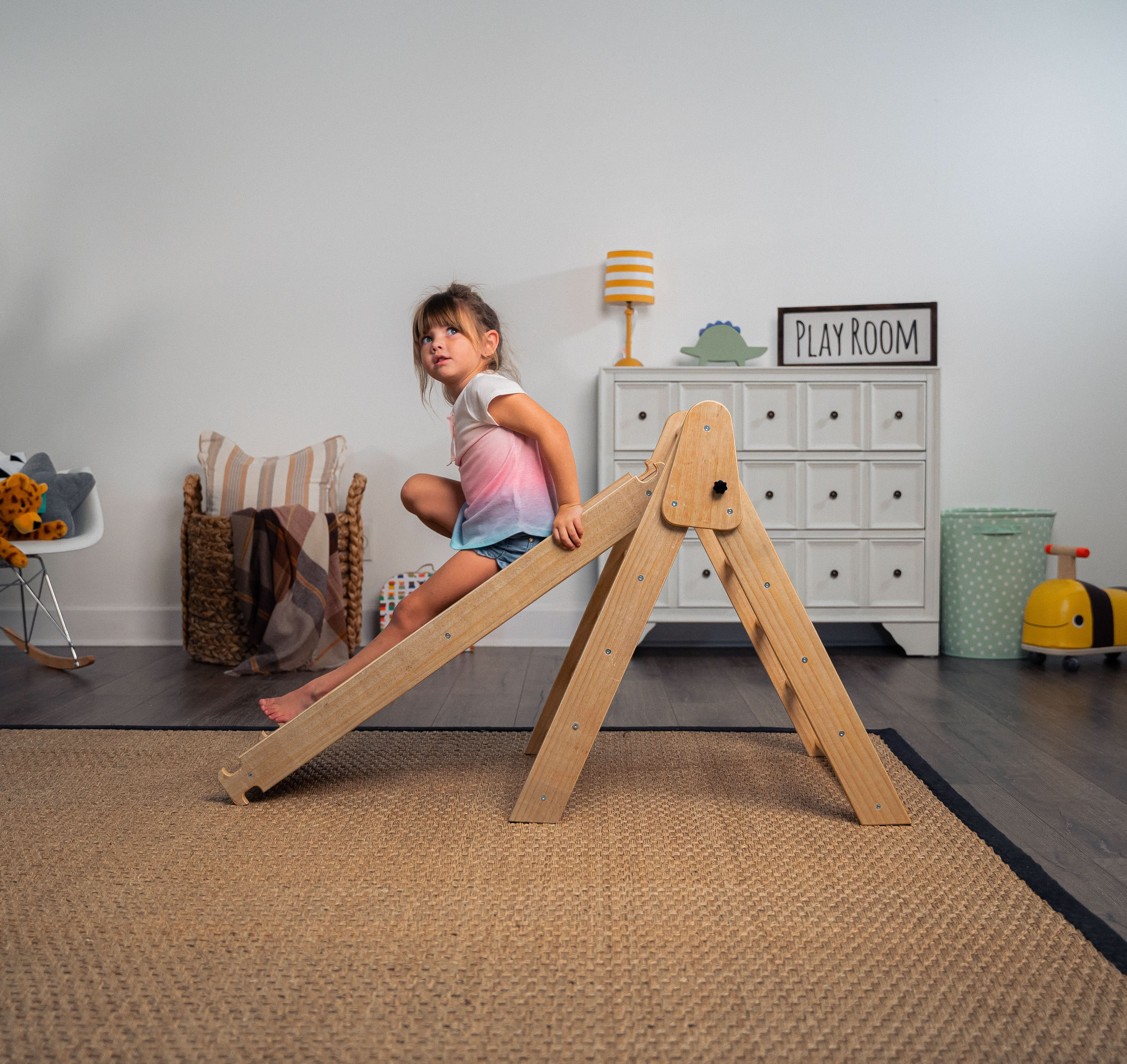
The heart of most Montessori climbing sets. An A-shaped wooden frame with rungs on both sides, used for pulling up, stepping, climbing over and, later, as the base for slides and ramps. Many fold flat for storage.
The climbing arch
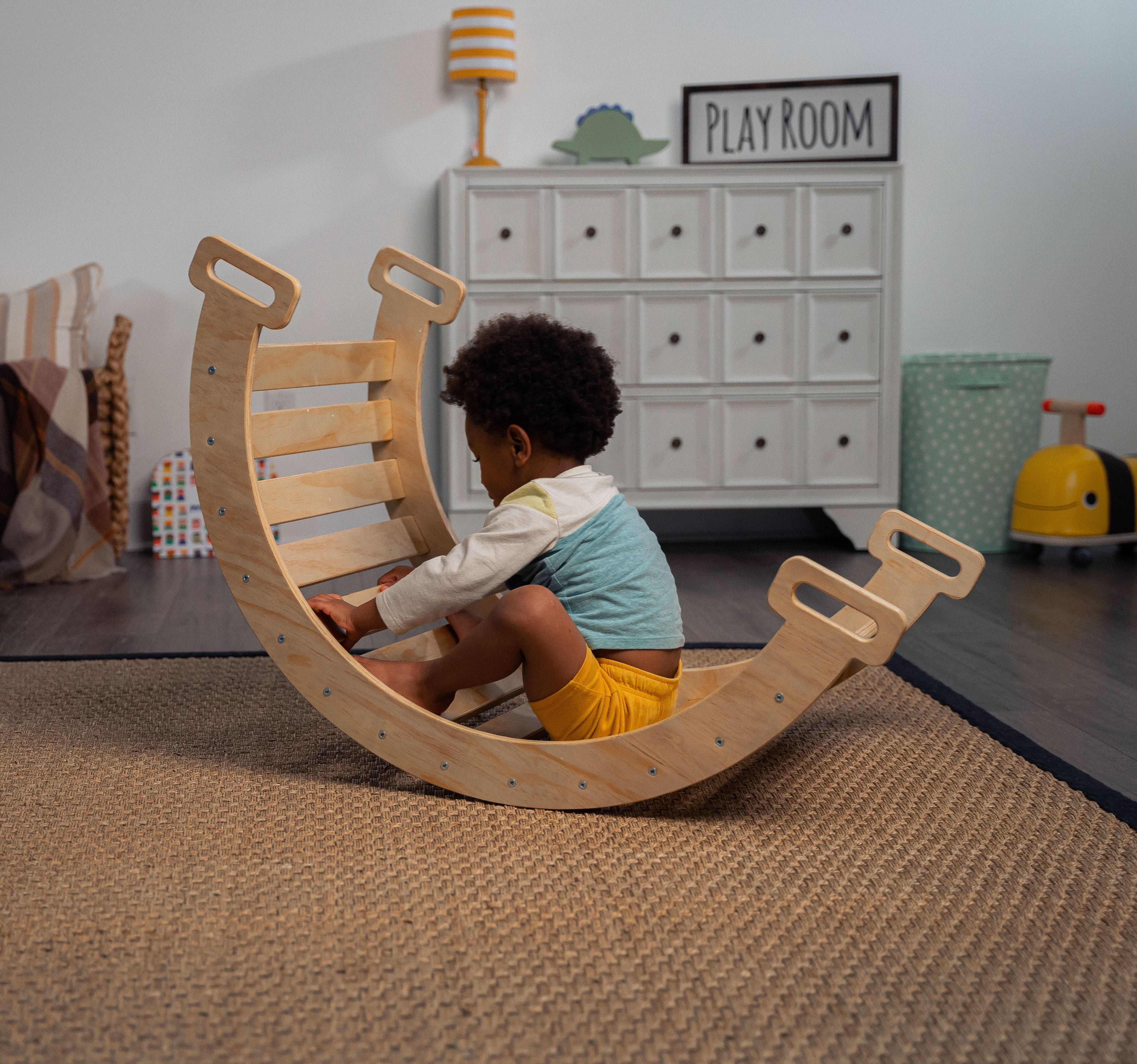
A curved wooden frame children climb over, crawl under or use as a bridge. Young toddlers often use it to pull up and cruise along the rungs.
The rocker
Many arches flip over to become a rocker, for rocking, balancing or curling up with a book. The Bailis is a climbing arch and rocker in one, for ages 18 months to 6 years.
The ramp and slide
A board that hooks onto the triangle or arch. One side is usually a smooth slide, the other a climbing ramp with grips, so children can climb up one way and slide down the other.
The rock climber
A ramp with handholds for a more challenging climb, often the first "rock wall" a toddler tries.
The Montessori jungle gym
A larger freestanding frame that combines several climbing activities, like a rock wall, rope ladder, slide and monkey bars, in one structure, for confident toddlers and preschoolers.
The Swedish ladder
A tall wooden ladder that mounts to the wall, often with a rope wall or rock wall alongside it. It is the climber children grow into, from preschool through the school years.
What Age Range Is Suitable for a Montessori Climber?
Most Montessori climbers start from around 1 year, when children are pulling up and taking first steps, and many are used until age 5 or 6. Here is how the pieces line up with each stage:
| Age | What fits | Examples |
|---|---|---|
| Around 1 year | A low Pikler triangle for pulling up and first climbs | Maple (ages 1 to 5) |
| 1 to 6 years | A Pikler set with a slide, ramp and arch | Hazel and Olive (ages 1 to 6) |
| 18 months to 5 years | A low climbing gym with a slide | Cherry |
| 2 to 6 years | A Montessori jungle gym | Magnolia and Bush |
| 3 years to adult | A Swedish ladder with a rope or rock wall | Neem |
Always follow the age range and weight limit for each climber, and go by your child's abilities as much as their age.
What Is the Best Montessori Climbing Set?
The best Montessori climbing set is the one that fits your child's stage and your space. Look for:
- The right height: low enough for your child to climb up and come down on their own. The Maple's triangle is just over 17 inches tall; the Hazel's is about 27 inches.
- Pieces that combine: a triangle, a reversible slide or ramp and an arch can be arranged into many routes, so the set grows with your child.
- Safety testing: CPSIA and ASTM compliance, smooth rounded edges and a stated weight limit. The Hazel, for example, is tested to CPSIA and ASTM standards, CPC certified and holds up to 220 pounds per child.
- A secure fold: if it folds for storage, it should lock firmly open during play.
- Room to add on: some climbers accept extra pieces later, like a roller slide, keeping a familiar set new.
For first climbs, start with the Maple. For one set from age 1 to 6, choose the Hazel. For an older toddler who wants more height, look at the Bazel, with a 29.5 inch triangle and a large rocker arch.
What Comes in a Montessori Climbing Set of 3?
A "set of 3" usually includes a Pikler triangle, a climbing arch and a ramp that doubles as a slide. Together they let children climb, crawl, slide and rock, and the pieces connect into new configurations as skills grow. What you pay for varies with the wood, size, finish, safety certification and extras like a rocker or cushion, so compare what each set actually contains. Our Pikler triangle buying guide compares our sets piece by piece.
Why Montessori Climbers Work
A climber lets children practice the climbing they will try on the sofa anyway, in a place built for it. Every climb is a small decision: where to put a hand, how high to go, how to get down. That builds strength, balance and coordination alongside problem solving and confidence. For more on the development side, see our guides to gross motor skills by age and how climbing builds young brains.
Keeping Montessori Climbers Safe
Put a soft mat underneath, especially on hard floors.
Keep it steady: on smooth floors, use a rug or non-slip pads so the climber does not slide when a toddler pulls up.
Check the locks and bolts regularly, especially on folding pieces.
Give it space, away from furniture, windows and shelves.
Supervise, and let children climb at their own pace rather than lifting them higher than they can reach themselves.
Quick Answers
Are Montessori climbers safe? Yes, when they are matched to the child's age and used with supervision, on a soft surface, with bolts and folding locks checked regularly.
Are Montessori climbers worth it? For most active toddlers, yes. They are used daily, support development, fold away in many cases and keep being used for years as children invent new ways to play.
What is the difference between a Montessori climber and a jungle gym? A Montessori climber usually means smaller, movable pieces like a triangle, arch and ramp that a child can rearrange. A Montessori jungle gym is a larger, fixed structure that combines several climbing activities in one frame.
Can a Montessori climber be used outdoors? Only if the manufacturer says so. Most are made from pine with indoor finishes and should stay inside.
Explore all our Pikler triangles, arches and rockers and indoor climbers.